Sunrise, Sunset, and Moving Swiftly Through the Days

A new month in a new year and it’s gone by far too quickly. I thought I’d close out the lengthening days of January by sharing some interesting sources of information. The pick for today is the NOAA Sunrise/Sunset Calculator, developed by some talented former colleagues. It is a resource used by people in all walks of life—from scientists and sky watchers to film makers and event planners—and a great way to explore what’s going on in terms of the number of hours of daylight received in a day.

According to the calculator, at 40 degrees latitude in the approximate middle of the mountain time zone, the apparent sunrise on January 31 is 7:09 a.m. and apparent sunset is 5:19 p.m. What’s “apparent” sunrise, you ask? Let’s use this graphic from the solar calculator Help Guide (really guys, great work putting this resource together!) to illustrate:

schematic showing reflection of visible light by atmosphere
Gases in Earth\’s atmosphere refract visible light from the Sun.

Earth’s atmosphere refracts (or bends) incoming light from the Sun. Because of that refraction, we see the sun “rise” shortly before it actually crosses the horizon. Likewise, we see the setting sun for a short time after the sun has actually “sunk” below the horizon at the end of a day. (If this part sounds like desperation from a person eager for any at all additional daylight, well, consider that mid-latitude winters sometimes just seem…long.) Apparent sunrise and sunset times are different than actual sunrise and sunset times, adding just that little bit of additional time to the number of hours of daylight in a day.

The nice thing about the end of January sunrise and sunset times is how they differ from the dark, dark days of December. Did we talk about the solstice on December 21? On that day, the apparent sunrise was at 7:18 a.m. but the sun was gone a full 40 minutes earlier, at 4:39 p.m. For those of us desperate enough to grab those few minutes based on apparent sunrise and sunset, 40 minutes seems quite a cause for celebration, or at least acknowledgment. Go ahead, play with sunrise and sunset times for your location, and check out what happens at the summer solstice too.

Earthquake Education

First, if you’re inspired to help those in Haiti, please see this list of organizations compiled by CBS News. This tragedy teaches us lots of things, about life, and the human condition, and vulnerability, especially as it relates to this planet on which we live. And sticking with the idea of linking teachable moments with topics on this site, today let’s consider plate tectonics and its relation to where and how people live.

Plate tectonics refers to the movement of Earth’s crustal plates. Earth’s surface, or lithosphere, is composed of about 12 of these plates, which can move next to, over, under, toward, and away from each other.

graphic showing tectonic plates and boundaries

All of these tectonic movements can cause earthquakes or volcanoes, and the infamous Ring of Fire is marked by the boundaries of the Pacific Plate with the North American, Nazca, Australian, Philippine, and Eurasian plates.

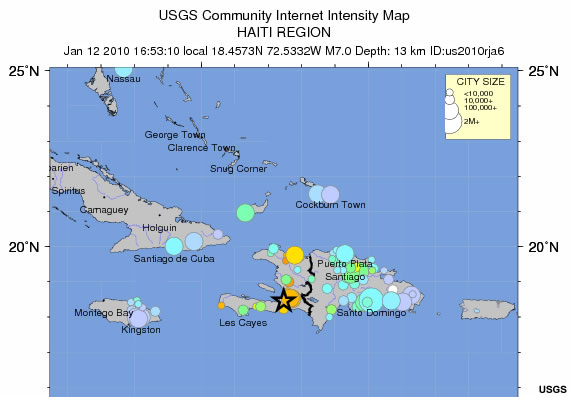
The January 12, 2010, earthquake in Haiti resulted from a break on the southern fault zone between the Caribbean plate and the Gonave microplate. While this area is not one of the more active earthquake zones on the planet, major earthquakes have occurred, often with devastating results. The January 12 event occurred on a “strike-slip” fault—one in which adjacent plates are moving against each other. Strike-slip events tend to be shallow and can therefore produce violent shaking over a sizeable area. According to the U.S. Geologic Survey (USGS), the magnitude 7.0 earthquake caused strong and very strong shaking in Haiti, with moderate shaking in the Dominican Republic and weak or light shaking as far away as the Bahamas.

plot of shaking intensities for January 12 earthquake

Tuesday’s earthquake reminds us of something we sometimes forget: that oftentimes the regions we don’t consider vulnerable to earthquakes are indeed places where major destruction and loss of life can occur. Where could the next big one happen? Scientists have identified several places where geology and population combine with potentially dangerous results. A few of them are viewable here.

Fun with Snow

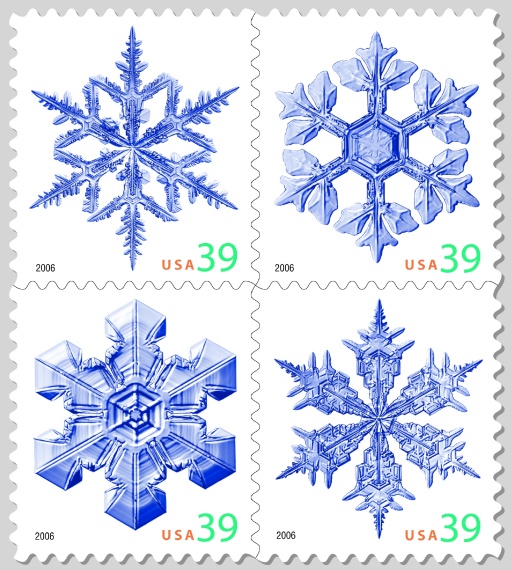
snowflake stamps from the United States Postal Service
The United States Postal Service released these snowflake stamps in October 2006.

Do you remember the year the United States Postal Service offered stamps with photos of lovely snowflakes? Those were by far my favorite holiday stamps to date, and one of the things I liked best was that USPS included some information about the images. For example, the stamps show three stellar dendrites and a sectored plate, each having its own unique characteristics, like every single snowflake out there. Nature. Is. Cool. You can view the original images, and learn more about the uniqueness of snowflakes and how to identify snowflake types, at this site by Cal Tech’s Kenneth Libbrecht, who photographed the snowflakes.

With the Northern Hemisphere winter solstice occurring in less than a week, I thought it would be a good time to pass along some experiments to let you have fun with snow. Check out this article by NCAR scientist Peggy LeMone and this one also. Ideas for a science fair project, perhaps?

And if you’re in the U.S. and want to report your snow (and other precipitation) measurements, check out the Community Collaborative Rain, Snow, and Hail Network (CoCoRAHS) —it’s a great citizen science opportunity.

Minerals. One of these things is not like the other…

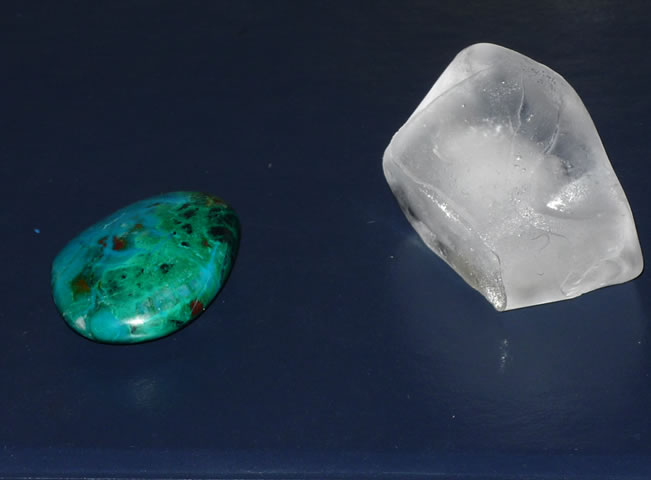
photo of chrysacolla and ice cube
(Left) Chrysacolla, a mineral formed in the oxidation zone of copper deposits. (Right) Ice, taken from my freezer.

Or it is? In keeping with divulging science facts, I wanted to tell you how many minerals there are out there. And to examine what a mineral actually is. Are both of the items pictured above minerals? How are they alike? How are they different? Let’s explore:

Wikipedia defines a mineral as “a naturally occurring solid formed through geological processes that has a characteristic chemical composition, a highly ordered atomic structure, and specific physical properties.” In looking through other definitions of “mineral” (and there are many), this one seems fairly comprehensive, especially because it contains the “naturally occurring” and “formed by geological processes” components. A mineral must also have a crystalline structure—the orderly geometric spatial arrangement of atoms. A former geology major explained to me that ice, therefore, is a mineral when it occurs in nature, but is not a mineral when it’s made in one’s freezer. Hmm, I’m thinking we’ve all seen freezers where it seems geological processes could indeed be going on, but guess the basic idea can hold. So while the two items above both have a crystalline structure, and as we’ll see in a bit, some similar physical properties, the chrysacolla is a mineral, but the ice cube is not.

The International Mineralogical Association is responsible for approving and naming new mineral species. Wow. Really cool! I want to get to name a mineral, but think of the pressure… OK, OK. According to the IMA, there are over 4000 known minerals. One web site I found listed 4714 different species, of which 4349 are IMA-recognized. Of the over 4000 known minerals, only about 100 occur commonly, 50 are “occasional”, and the rest are apparently “rare” or “extremely rare”.

Now, put one or more minerals together in an aggregate, and you get a rock. The mineral calcite is a primary component of the rock limestone, for example. So common every day rocks can offer great opportunities for studying minerals. If you don’t have anywhere to go out and dig, the web is not all that bad a place for exploring minerals. There are cool alphabetical lists of minerals, some with pictures and accompanying geeky info. Here’s ice, for example.

One could spend a really long time perusing these lists, or a handy dandy mineral reference book like Eyewitness Handbooks Rocks and Minerals, which I acquired as a previously used copy last summer but have really not given the field time it deserves. These guides will help you understand minerals based on their properties—things like hardness, luster, color, streak, cleavage, and fracture. Hardness, for instance, is rated on a scale from 1 to 10, with a diamond being a 10 (the hardest). The chrysacolla shown above has a hardness of about 2.6, and ice is similar, with a hardness of 2.5. Apparently a mineral’s hardness has a lot to do with its suitability as a gemstone…corundum (which occurs as either red—a ruby, or blue—a sapphire) has a hardness of 9, which is twice as hard as topaz (8) but only ¼ as hard as a diamond. Feeling up to one more fact for today? That hardness scale was developed in 1812 and is courtesy of the German mineralogist Friedrich Mohs. I checked to see if Mohs also had any sort of mineral named after him, but couldn’t find one. Having your name attached to *all* minerals though, that just might be sufficient enough.