Gluttons for Our Doom

There are so many topics I could share with you, but somehow all of them seem depressing to me. Like possibly irreversible ‘dead zones’ in the Pacific Ocean. Instead, in honor of the remaining seven weeks in this year’s largely quiet Atlantic hurricane season, let’s revisit Gilchrist, Texas, on the Bolivar Peninsula.

Gilchrist, Texas, was built on the narrowest part of a peninsula that at its highest point is only 10 feet above sea level. In 2008, Hurricane Ike brought winds of over 110 mph coupled with a 14-foot storm surge and waves topping 20 feet. The storm knocked 99 and 1/2% of the town’s 1000 buildings off their foundations and left virtually no surviving infrastructure in the community – electrical and water systems, bridges and roads, everything, needed to be reconstructed.

It’s not a location that is alone. Take a look at these statistics: in recent years, $11 or 12 billion dollars in damage from a single storm has become commonplace. Hurricane Katrina resulted in $100 billion in uninsured losses, cut U.S. economic growth by a full 1/2 percent, and by 2008 had required U.S. government spending of more than $200 billion.

Compare these billion dollar losses with the estimated $25 – 37.5 million per year in insurance premiums nationwide and you’ll get an idea of why these storms cost taxpayers all across the country. When Andrew destroyed 60,000 homes in Florida in 1992, it bankrupted 11 local insurance companies.

Hurricanes happen. And about 35 million people live along the coastline from North Carolina to Texas, the region that is most likely to be impacted by hurricanes. At least some of these millions of people live in areas that are just as or even more vulnerable than Gilchrist. It’s now a year since that town was mostly washed away for the second time in three years, and currently, Gilchrist, Texas, is being rebuilt.

It’s simple, really: We Americans seem to be bad at being told what to do, but we’re perhaps even worse at being told what not to do. People are going to continue to live in coastal areas for a variety of reasons, and even suggesting that perhaps some areas should not be built upon is likely to provoke the masses. Still, perhaps the provoking will lead to discussion, and ultimately an informed dialog, about locations, building codes, and vulnerability to nature. However we view the fate of Gilchrist, it’s a vivid example of the importance of understanding how our natural environment can influence our lives and livelihoods. In education, it’s called a teachable moment.

Flying by Mercury

New 2009 images of the planet Mercury
New 2009 images of the planet Mercury. Photo credits: NASA/Johns Hopkins University Applied Physics Laboratory/Carnegie Institution of Washington

Left: This unnamed impact basin, with outer diameter approximately 260 km (160 mi), was seen for the first time on September 29, 2009, during MESSENGER’s third flyby of Mercury. Right: An unnamed crater viewed at close range for the first time on September 29, 2009, during MESSENGER’s third flyby of Mercury. The crater displays an arc-shaped depression known as a pit crater on its floor.

“Participated in collecting ground-breaking views of the last of the eight planets in the solar system to be fully seen.”

Not a bad line for a resume, especially if you are still a 6th grader.

Yesterday, NASA’s MESSENGER spacecraft flew by the planet Mercury on its way to establishing orbit around the nearest planet to the Sun in 2011.

The flyby’s ground support on Earth included a team of science educators working hand-in-hand with mission scientists. The science educators were onboard to communicate the findings to classrooms all across the U.S. and give students the opportunity to join in the adventure.

Students were invited to follow updates, ask questions, and participate in live conversations about the preliminary images in real-time as the data were streamed here to Earth. Such exciting opportunities for students to be on the cutting edge of learning about another part of our solar system don’t come along often. It’s also a chance for them to see how scientists approach the exploration process and go about interpreting data. The discussion will continue for a couple more days, so check it out. You can also get your own views of first-ever seen features of Mercury on the mission’s website.

Plant Phenophases and Citizen Science

aspens color the hillside during the Colorado autumn
Golden aspens color the hillside during autumn in Colorado. Photo ©sciencespeak.org

It’s one day after the autumnal equinox and rather chilly here along the Rocky Mountain Front Range. The aspens in the mountains are a blaze of yellow, and the other day I saw the first leaves turning color down at this elevation. We see these yellow, orange, and red colors in the fall leaves as trees shut down in preparation for winter. The shorter daylengths cause trees to stop producing chlorophyll, so that anthocyanins (red pigments) and carotenoids (yellow and orange pigments) become visible.

Changes in leaf color are an example of a phenological change. Phenology is the study of the timing of life cycle events in plants and animals—budburst, flowering, animal migration, and other events. Farmers have long been aware of how phenological observations relate to agricultural production, but more recently the observations have found increasing use in science, particularly for tracking the effects of climate variability and change.

Phenological observations provide a great opportunity for citizen science. Citizen science projects allow anyone willing to do some observing to report their findings and contribute to scientific analysis and research. One of my goals is to share these opportunities with you, when possible, and Project Budburst is a great one. It’s simple to participate: take a look around, and if you have kids, encourage them to look with you. Watch for seeds ripening, leaf color change, leaf drop, and other phenological events documented on the website, and login and report your observations. This important citizen science project has a goal of recording 5,000 phenophase observations this fall. You can help them get there, and do some learning and sharing about science all while enjoying the spectacular fall colors!

A Magic Kayak Ride

Black_Hole_KAYAKER

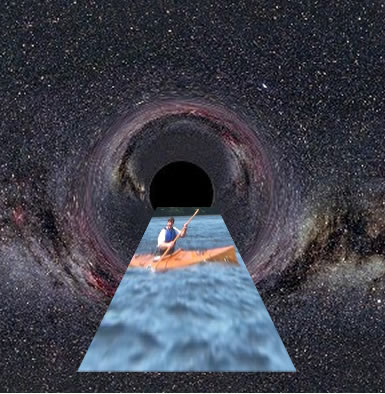
Come along with me little girl, on a magic carpet, er, kayak ride…or really, in this case perhaps you should just say no.

This note recently came from a friend of mine:  “The other day, as we were driving, Amelia started asking about black holes.  She was incredibly scared of them.  She asked me if a person was in a kayak could they really fall into a black hole!” What?!

Rewind to about two years earlier, when her daughter was four years old. We had gone together to a show on black holes at a planetarium. The show was well done in many ways, but in a dramatic scene demonstrating the “place from which nothing escapes, not even light”, a kayaker paddling along through space becomes pulled into the black hole without any way out. Because kayakers paddle through space all the time, didn’t you know?

The planetarium show was probably not designed for someone of age four. But this particularly precocious four-year-old saw it, and two years later remembered the part about the kayak being pulled into the black hole vividly enough to ask questions about it. Inquiry—a fine thing! And in this case, the inquiry led to the ability to confront the misconceptions head on. My friend explained that black holes are very far away out in space and that kayaks here on Earth won’t get sucked in, that the scene was just trying to show how the black hole sucks stuff in. Her precocious now-six-year-old replied, “well, that was really silly of them to show people in boats getting sucked in!” Ah yes, silly indeed.

It’s a good reminder for those of us working in science or education or at the interface of the two that we need to be very careful about what we present. It’s much more difficult to correct a misconception that has already been “learned”, and often difficult to pinpoint what the misconception even is.  It’s obvious that we need to plan carefully and teach things correctly and accessibly from the start. It can be tough though, so we should also watch for those times when a smart student will call us out and say, “well, that was really silly.” Indeed.