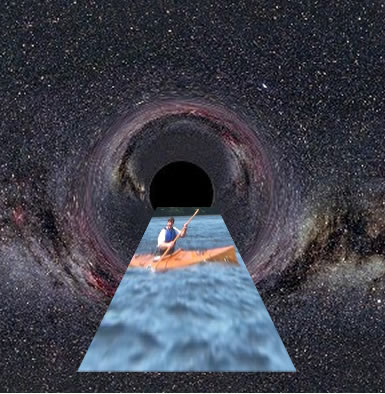
A Magic Kayak Ride

Black_Hole_KAYAKER

Come along with me little girl, on a magic carpet, er, kayak ride…or really, in this case perhaps you should just say no.

This note recently came from a friend of mine:  “The other day, as we were driving, Amelia started asking about black holes.  She was incredibly scared of them.  She asked me if a person was in a kayak could they really fall into a black hole!” What?!

Rewind to about two years earlier, when her daughter was four years old. We had gone together to a show on black holes at a planetarium. The show was well done in many ways, but in a dramatic scene demonstrating the “place from which nothing escapes, not even light”, a kayaker paddling along through space becomes pulled into the black hole without any way out. Because kayakers paddle through space all the time, didn’t you know?

The planetarium show was probably not designed for someone of age four. But this particularly precocious four-year-old saw it, and two years later remembered the part about the kayak being pulled into the black hole vividly enough to ask questions about it. Inquiry—a fine thing! And in this case, the inquiry led to the ability to confront the misconceptions head on. My friend explained that black holes are very far away out in space and that kayaks here on Earth won’t get sucked in, that the scene was just trying to show how the black hole sucks stuff in. Her precocious now-six-year-old replied, “well, that was really silly of them to show people in boats getting sucked in!” Ah yes, silly indeed.

It’s a good reminder for those of us working in science or education or at the interface of the two that we need to be very careful about what we present. It’s much more difficult to correct a misconception that has already been “learned”, and often difficult to pinpoint what the misconception even is.  It’s obvious that we need to plan carefully and teach things correctly and accessibly from the start. It can be tough though, so we should also watch for those times when a smart student will call us out and say, “well, that was really silly.” Indeed.

Our Private Universes

A few weeks ago I had the opportunity to teach the basics of energy balance, seasons, and atmospheric & ocean circulation to a group of non-scientist coworkers. Though I was directed specifically to “make sure they understand” the seasons part, I felt a little odd about presenting info the audience probably already knew. After all, shouldn’t we all have learned that in 6th grade science class, or at least in high school?

Apparently not, at least according to “A Private Universe”, a 1989 video in which graduates at Harvard University are asked this question. Over 90 percent of them are unable to give a correct answer. It’s an illuminating piece of work and still referenced all these years later. [To me, it begs the question, where is the update? Seriously, if you are aware of such a product, please let me know.]

The bottom line of “A Private Universe” is that traditional instructional methods don’t really help students learn the concepts, because these methods cannot overcome the misconceptions students already possess. The video makes a compelling argument for inquiry-based learning and giving students the opportunity to explore and seek out the correct answers. In the misconception about seasons depending on Earth’s distance from the Sun rather than Earth’s tilt: if the Earth-Sun distance was the answer, why wouldn’t the Northern and Southern Hemispheres experience summer at the same time? How would you explain the difference in the hours of daylight between summer and winter?

For some people, I suppose these aren’t nagging topics requiring explanation. They are merely “things that are” and why is not important. But wouldn’t it be good if we could all be just a little bit curious about this world in which we live? Wouldn’t it good if we had a solid enough grounding in the inquiry process that we could now at least ponder the questions intelligently?

I have a lot of thoughts about science, about learning and teaching, about exploring, about the natural world and what we do and don’t understand, and here I am with a whole blog space to fill. Next post, come along with me on a magic kayak ride…